Challenge
Most families do not have a data-recovery problem; they have a data-scatter problem. Twenty years of photographs, documents and records sit across old laptops, phones, external drives and memory cards — and the people holding them are rarely technical. A service that collects and preserves that material has to earn trust before it earns a booking: customers are handing over devices that may belong to parents or deceased relatives, and the files are as personal as data gets.
So the engineering brief was as much about what the system must not do as what it must do: no browsing of customer files, no AI training on customer content, minimal personal data stored, and every device and job accounted for from intake to secure deletion.
Engineering approach
- One runtime, small surface. The public site, the risk assessment, the customer portal, payments and the staff back office all run in a single Cloudflare Worker with server-rendered pages. There is no separate application server to patch.
- Store metadata, not memories. The database holds operational metadata — jobs, devices, custody events, aggregate file counts and sizes, verification status — never customer file contents or bulk filename lists.
- Make history tamper-evident. Job status history and custody records are append-only, enforced by database triggers. Money is stored as integer paise; times in UTC.
- Authorise every object. Staff permissions are enforced server-side on every admin route, technicians see only jobs assigned to them, and customer portal queries are always scoped to the signed-in customer. Customers sign in by single-use magic link; staff passwords use PBKDF2 with lockout.
- Keep files private by default. Documents live in private object storage and are served only through HMAC-signed URLs that expire after five minutes, issued after an authorisation check; uploads are type-checked by content, not extension.
- Take payment amounts from the server. Payment orders are created server-side from the outstanding balance in the database, and payment confirmation arrives by signed webhook — the browser never sets the amount.
Solution
- A public site with an interactive digital-legacy risk assessment (14 questions in four steps, with a no-JavaScript fallback) that scores risk in plain language and offers do-it-yourself, assisted and full-service routes.
- Enquiry and callback forms protected by Turnstile, rate limits and schema validation, each generating a unique reference.
- A customer portal for job status, documents and payments.
- A staff back office covering leads, quotes, jobs, device custody, payments and reporting, with an audit log on every change.
- A daily scheduled task that moves completed jobs into their retention period, sends reminders and runs clean-up.
- Security headers (HSTS, a strict Content Security Policy, frame denial) and HTTPS enforcement in the Worker itself rather than as zone-wide settings.
Outcome
- LegacyData by Kamyab is live in production at legacydata.kamyab.co.in.
- The application runs entirely on Cloudflare’s platform — Workers, D1 and R2 — with an automated test suite that exercises real D1 and R2 bindings locally before deployment.
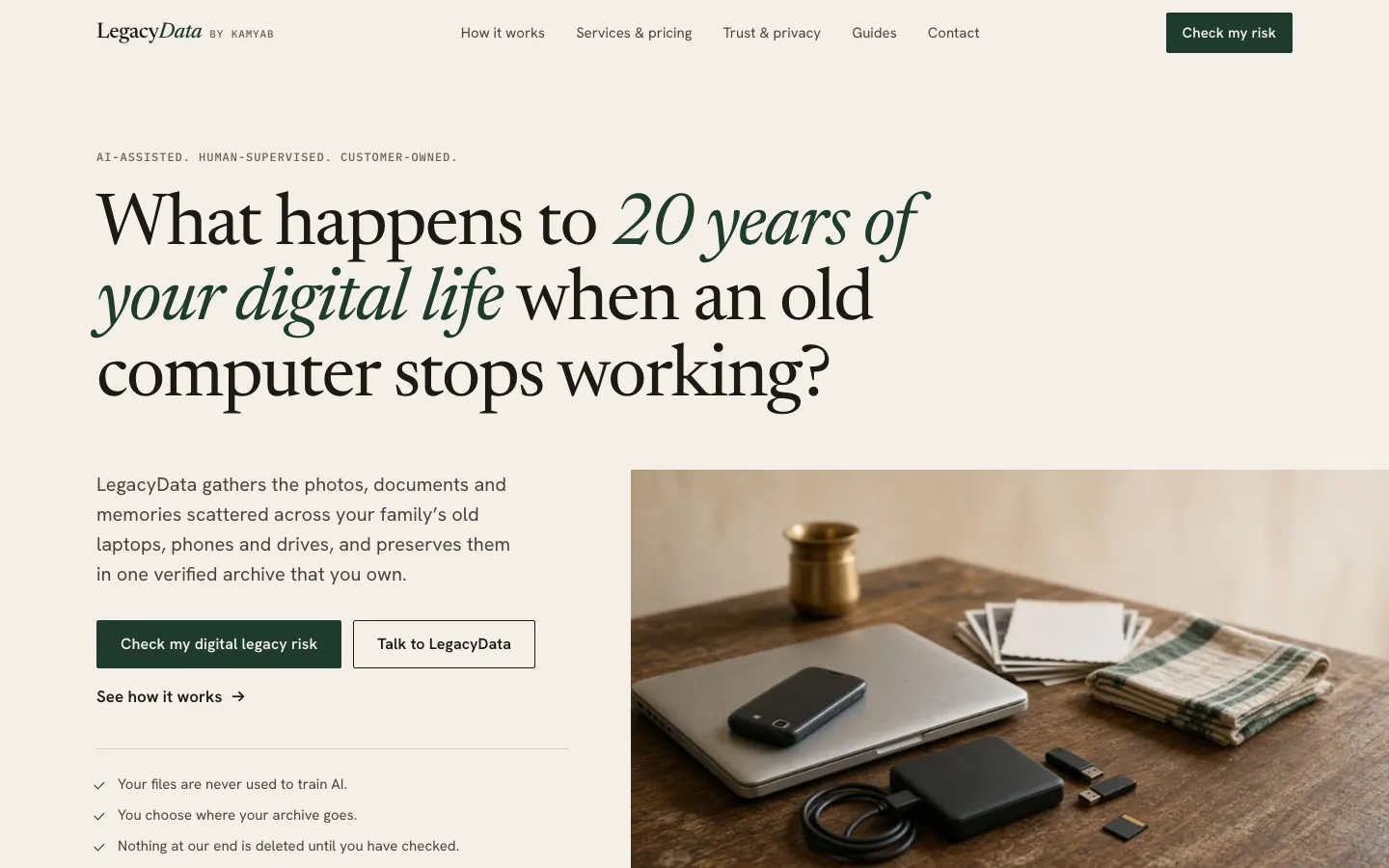
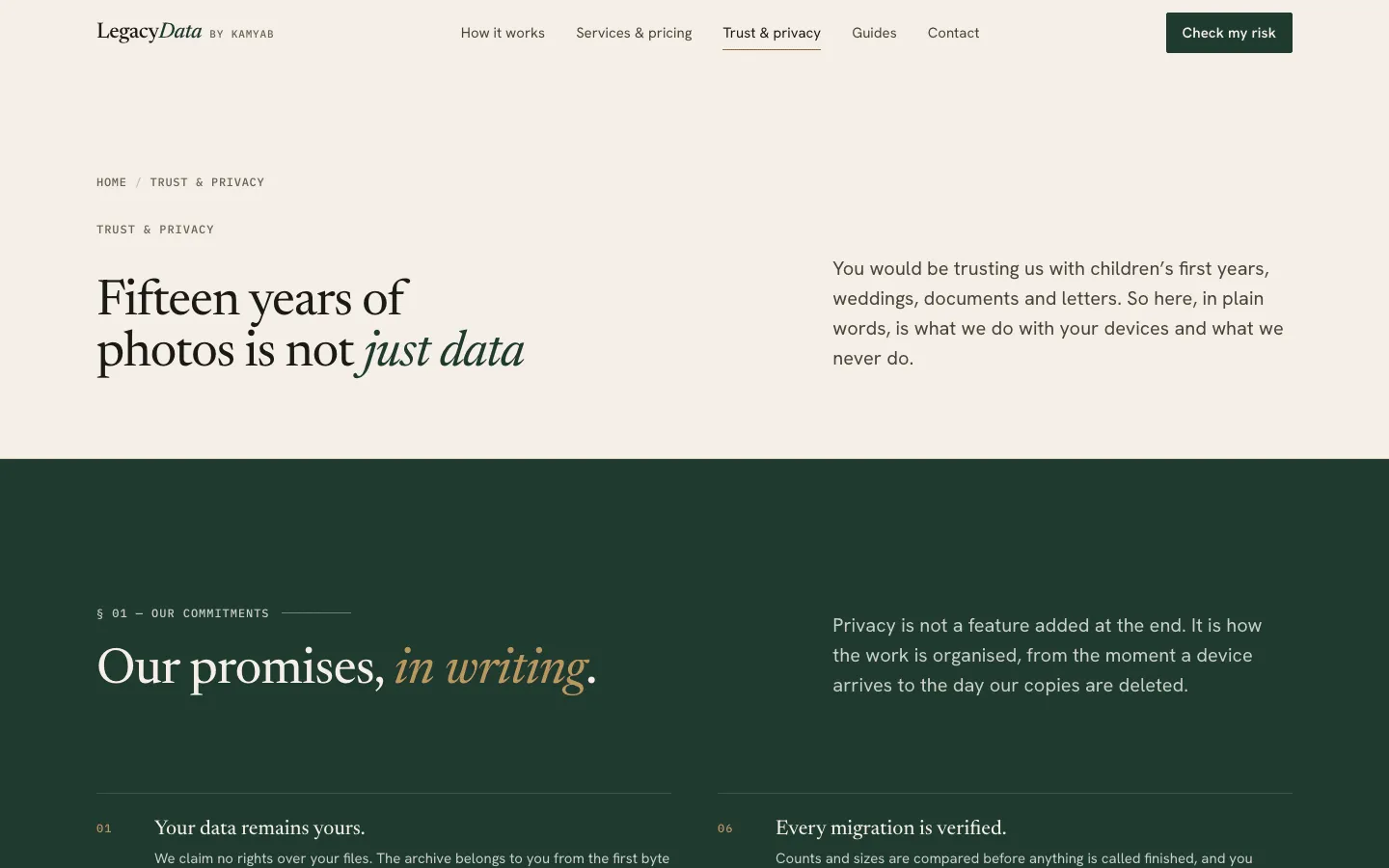
- The privacy commitments on the public site (customer-owned archives, no AI training on customer files, nothing deleted before the customer has checked) are backed by the data model and access controls described above, not just by policy text.